
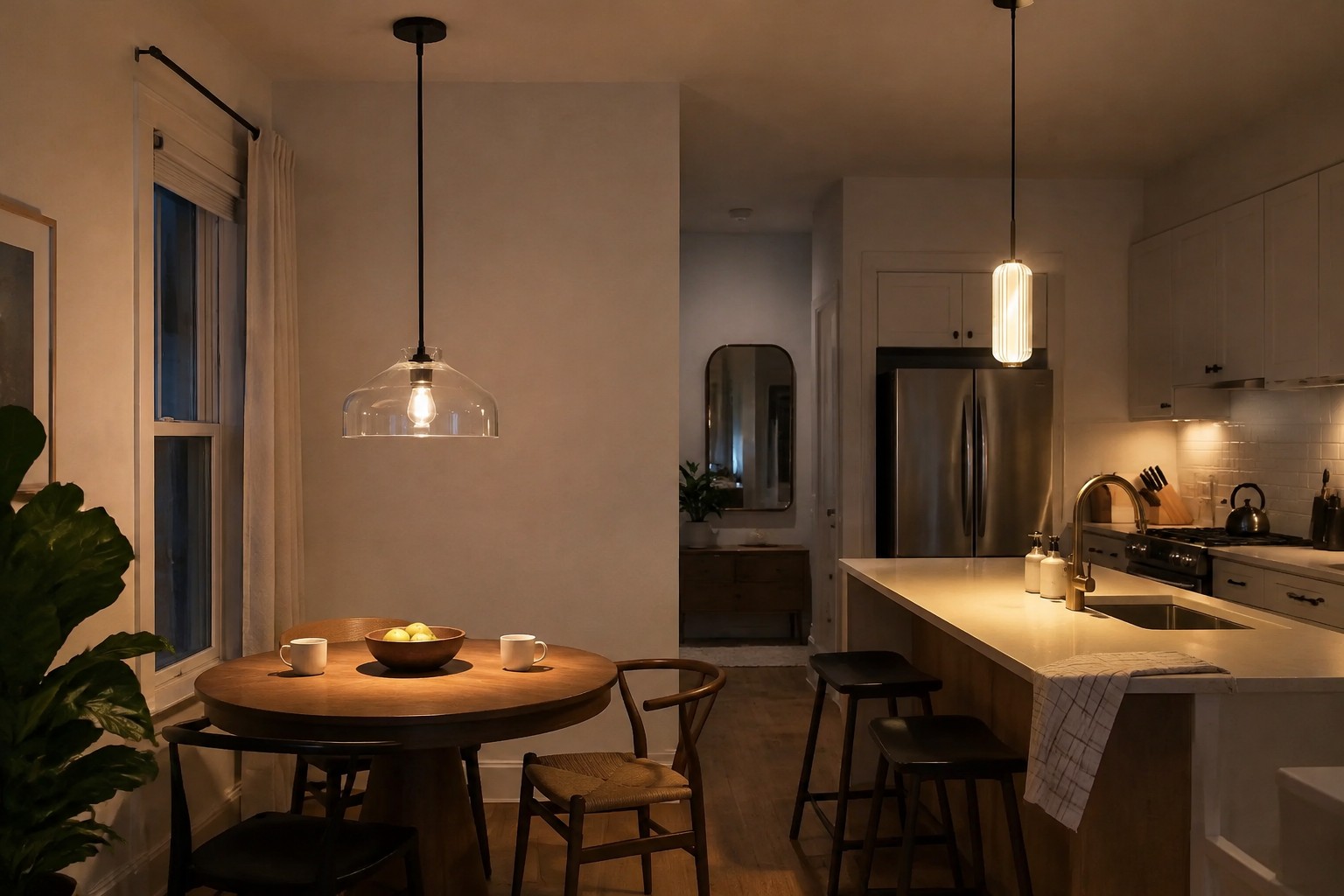
 When shopping for a pendant light, you may encounter terms such as “E26 socket,” “LED pendant” and “integrated LED.” Although all three can relate to LED lighting, they do not describe the same type of light-source system.
An E26 pendant uses a standard socket that keeps the bulb separate from the fixture. An integrated LED pendant has its LED light source built directly into the body. Both can provide energy-efficient light, but they offer different experiences when it comes to replacement, color temperature, dimming, maintenance and future upgrades.
If practicality means being able to replace the bulb, change the light later and avoid dependence on proprietary components, an E26 pendant is usually the stronger option. If practicality means receiving a slim, purpose-designed fixture with an already-integrated light source, an integrated LED pendant may be more suitable.
The real question is not which technology is more advanced. It is whether you value future control or a complete integrated experience today.
First, E26 and Integrated LED Do Not Mean the Same Thing
What is an E26 pendant light?
E26 describes the socket rather than the technology inside the bulb. The “E” refers to an Edison screw base, while “26” refers to a thread diameter of approximately 26 millimeters.
An E26 socket can accept a compatible LED bulb. This means E26 pendant lights and LED pendant lights are not opposing categories. An E26 fixture can still use LED as its light source.
Its defining characteristics are:
- The bulb remains separate from the fixture;
- The user can normally replace the bulb;
- Brightness and color temperature depend on the selected bulb;
- A different compatible bulb can be installed later.
The Hanton Nordic Minimalist Pendant Light follows this structure. Its E26 socket allows the owner to select a bulb according to the room and intended use.
What is an integrated LED pendant?
An integrated LED pendant incorporates an LED board, module or other light-source component directly into the fixture. It normally does not provide a standard E26 socket for a user-installed bulb.
The light source, driver, fixture body and diffuser are generally designed as a complete system. This allows the pendant to be thinner, longer or more sculptural, but it also means that replacing the light source is not as simple as unscrewing a conventional bulb.
The Elma Linear Pendant Lamp uses an integrated LED light source. Its LEDs are built into the fixture and cannot be replaced like an ordinary bulb. Its slim linear form demonstrates one of the major design advantages of integrated LED technology.
E26 vs Integrated LED at a Glance
| Consideration | E26 replaceable-bulb pendant | Integrated LED pendant |
|---|---|---|
| Light-source structure | Bulb remains separate | LEDs are built into the fixture |
| Light replacement | Bulb can usually be replaced | Depends on module, driver and repair design |
| Brightness changes | Install a bulb with different lumen output | Usually determined by the built-in source |
| Color-temperature changes | Install a different bulb | Depends on whether selectable color is included |
| Dimming | Requires a compatible bulb, dimmer and circuit | Requires a compatible driver and control system |
| Smart lighting | May accept a suitable smart bulb | Must be supported by the fixture |
| Fixture shape | Must accommodate a socket and bulb | Can be thinner, linear or unusually shaped |
| Initial setup | Bulb may need to be purchased separately | Light source is usually included |
| Long-term flexibility | Generally higher | More dependent on the original design |
Integrated does not mean lower quality, and replaceable does not mean maintenance-free. The two systems simply place control in different hands.
1. Replacement Is the Biggest Practical Difference
The clearest difference often appears after installation, when the light source begins to dim, flicker or fail.
When an E26 bulb develops a problem
When an E26 bulb reaches the end of its useful life, the owner can usually:
- Switch off the light and relevant power;
- Allow the bulb to cool;
- Remove the old bulb;
- Install a compatible replacement.
The shade, suspension and canopy normally remain in place. Provided that the socket and other electrical components are still working properly, the end of the bulb’s life does not mark the end of the entire pendant.
This is the central practical advantage of an E26 fixture such as the Hanton. The light source remains a separately manageable component.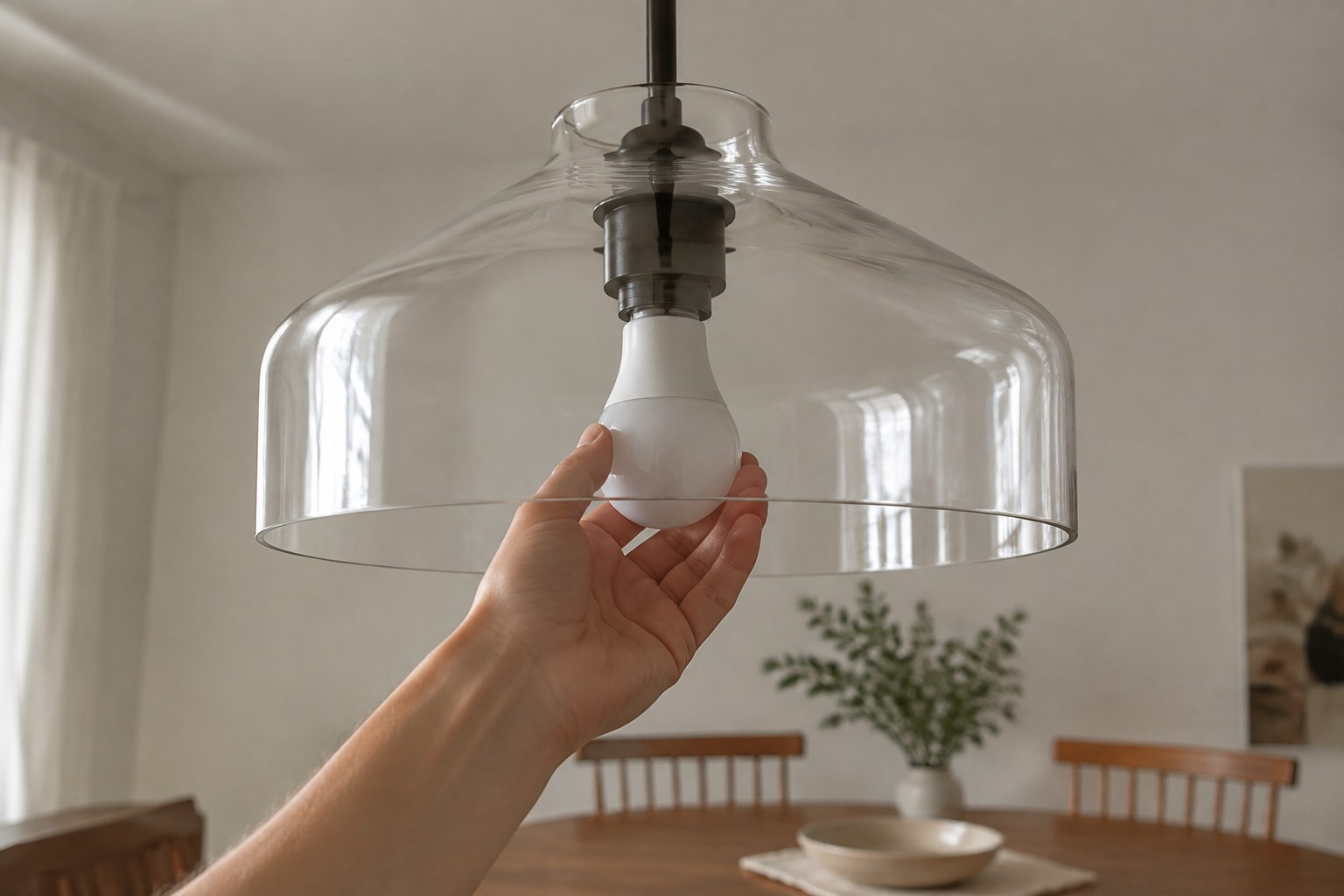
When an integrated LED develops a problem
The situation is more complicated with integrated LED.
Dimming, flickering or failure may involve:
- The LED module;
- The LED driver;
- An electrical connection;
- A control component;
- Excess heat or poor thermal management;
- Another internal component.
Some integrated fixtures allow a manufacturer or qualified technician to replace the driver or LED module. Others do not provide a user-replaceable light source.
A failed integrated LED does not always mean that the entire pendant must immediately be discarded. The outcome depends on the construction, availability of replacement parts, warranty and manufacturer support.
The Elma product information states that its built-in LEDs cannot be replaced like an ordinary bulb. A buyer should therefore understand how a light-source or driver problem would be handled instead of relying only on an advertised LED hour rating.
2. Rated Lifespan Does Not Decide Practicality by Itself
Bulb or LED-module hour ratings are often treated as the lifespan of the complete fixture. That comparison is incomplete.
E26 is only a socket specification. It does not have one universal lifespan. Different LED bulbs installed in the Hanton may have different wattages, quality levels and rated operating lives.
The performance of integrated LED depends on factors such as:
- LED-chip quality;
- Driver quality;
- Thermal design;
- Operating temperature;
- Daily operating time;
- Voltage conditions;
- Dimmer or control compatibility.
LED lifespan also does not necessarily describe the moment the light suddenly stops working. ENERGY STAR explains that LEDs typically experience gradual lumen depreciation, with useful life commonly evaluated according to when output falls to a defined level.
Comparing a 25,000-hour bulb with a 50,000-hour integrated module does not provide the complete answer. Buyers should also consider:
- What happens after the light output declines;
- Whether the driver can be repaired;
- Whether replacement components are available;
- Whether service requires a professional;
- Whether the original brightness and color temperature will remain desirable.
A light source with a longer rating is not automatically the more practical fixture if another failed component cannot be serviced.
3. E26 Gives the Owner More Control Over Future Light Quality
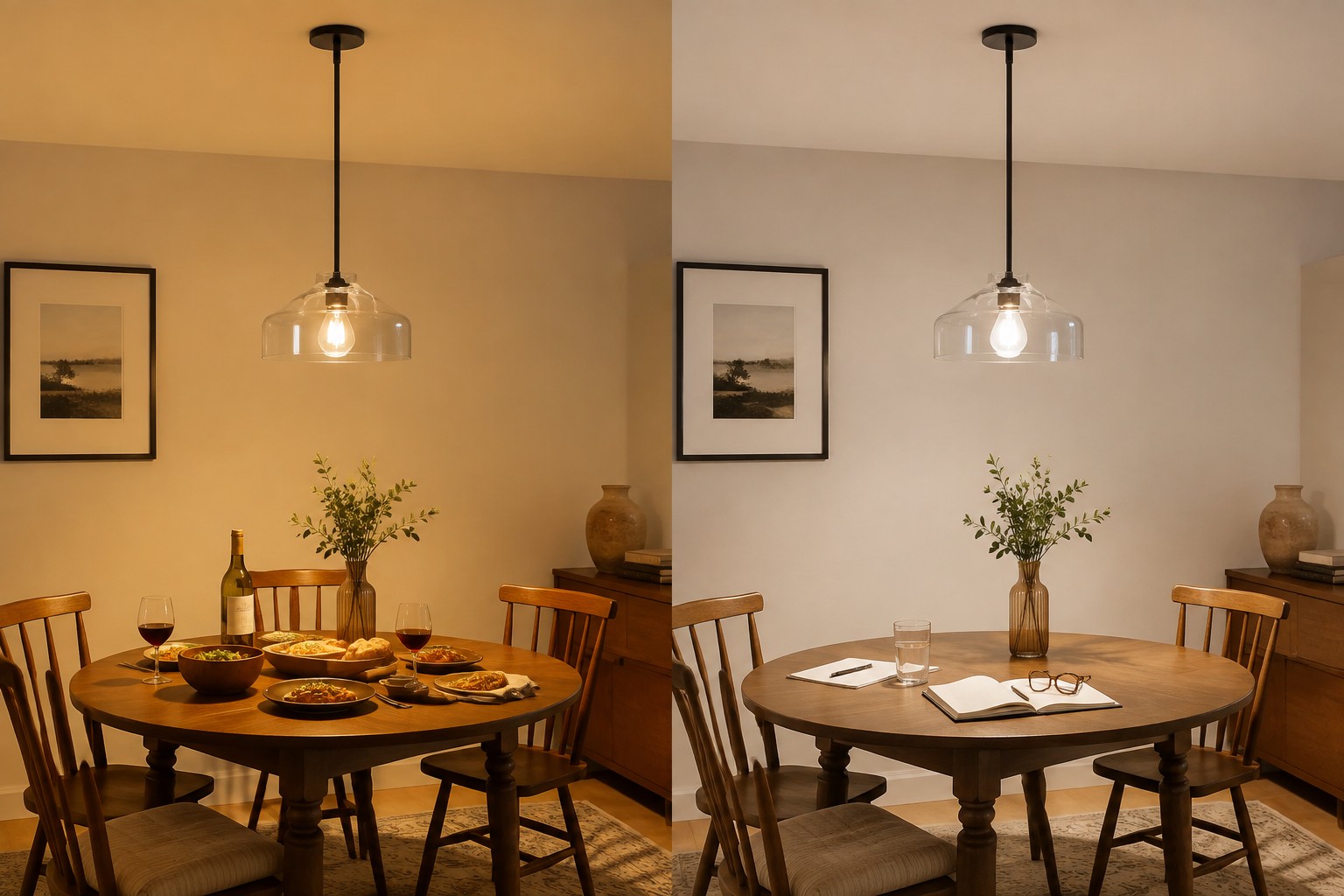
The main advantage of E26 is not that every bulb lasts longer. It is that the owner can reconsider the light source later.
Household lighting needs may change after installation:
- The light over the dining table feels too bright;
- A clear bulb produces uncomfortable glare;
- The kitchen needs clearer task lighting;
- Warm light no longer complements a new wall color;
- The owner wants to add smart controls;
- A dining area becomes a workspace.
With a compatible E26 bulb, the owner may be able to change:
- Lumen output;
- Color temperature;
- Color-rendering performance;
- Clear or frosted appearance;
- Light distribution;
- Dimming capability;
- Smart control features.
This means the Hanton can function as more than a fixture with one permanently fixed lighting effect. It provides a framework in which the bulb can be reconsidered later.
That flexibility still has limits:
- The bulb must remain within the fixture’s specified wattage;
- Its dimensions must fit inside the shade;
- Smart bulbs may be larger than ordinary bulbs;
- Replacing the bulb cannot change the metal shade’s basic light distribution;
- A dimmable bulb still needs a compatible dimmer and electrical system.
4. Integrated LED Allows Greater Freedom in Fixture Design
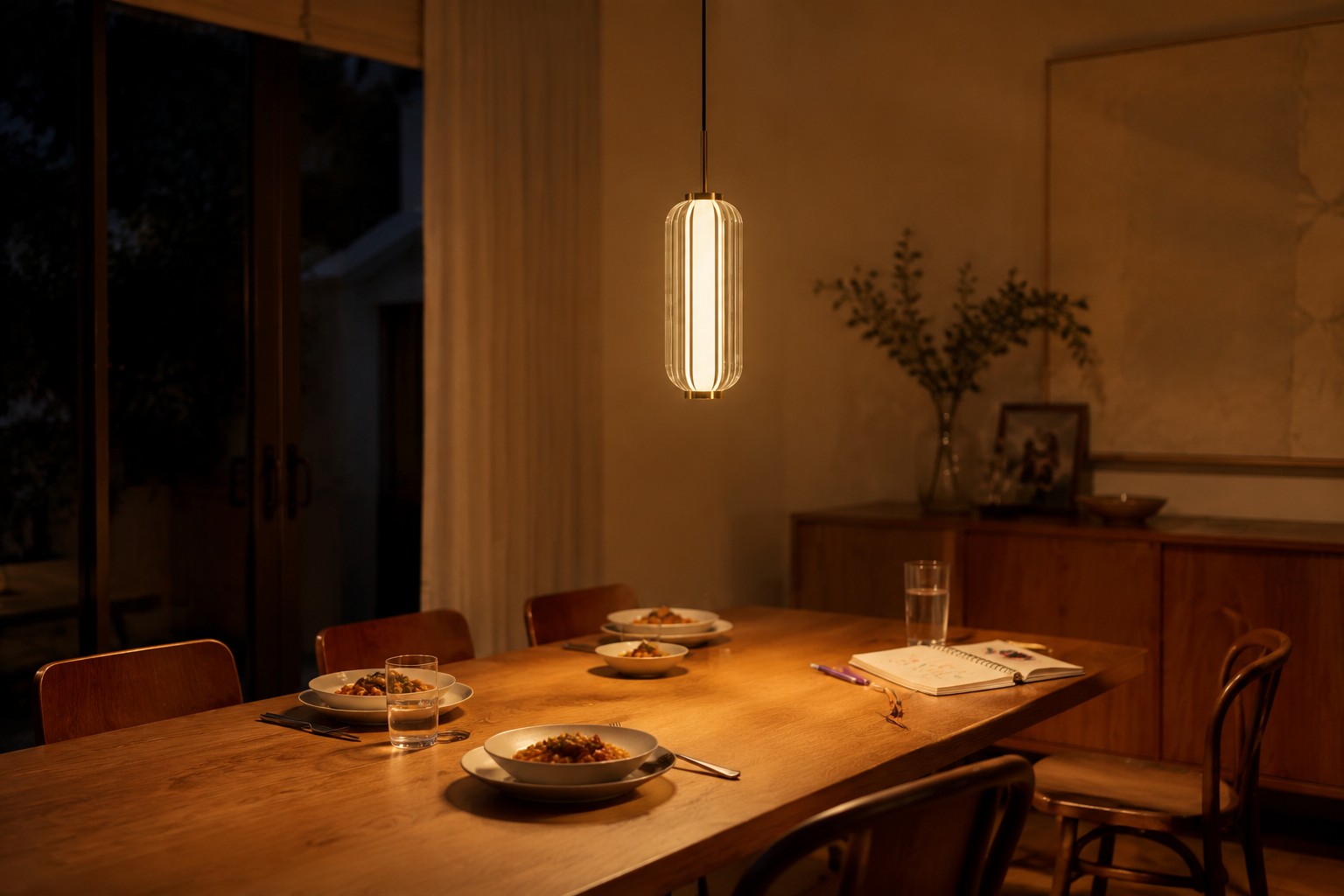
A standard E26 bulb and socket require physical space. They influence the depth of the shade and the proportions of the fixture.
Because integrated LEDs do not need to follow the shape of a conventional bulb, designers can create:
- Thinner fixture bodies;
- Long linear profiles;
- Rings and curved forms;
- Continuous illumination along the body;
- Concealed light sources;
- More uniform diffused light;
- Architectural or sculptural shapes.
The Elma’s linear form is a useful example. Its light source, body and light distribution are designed as one system. Achieving the same slim proportions and continuous effect with conventional E26 bulbs would be difficult.
The value of integrated LED is not simply that it is “more advanced.” Its value is that it enables forms and light distribution that standard bulb-based construction may not support.
For buyers who treat the pendant as an architectural element and prioritize clean continuous lines, integrated LED may be more practical than a conventional bulb structure.
5. Which Option Is Easier to Dim?
Dimming is not determined by the words “E26” or “integrated LED” alone.
Dimming an E26 pendant
An E26 pendant generally needs three compatible elements:
- A dimmable bulb;
- A dimmer designed to work with that type of LED bulb;
- A suitable circuit and installation.
The advantage is that if one bulb has an unsatisfactory dimming range, stability or color quality, the owner may be able to install another compatible bulb without replacing the fixture.
The Hanton may be paired with a suitable dimmable E26 bulb and compatible dimming system. It should not be described simply as unconditionally dimmable without mentioning those requirements.
Dimming an integrated LED pendant
With an integrated fixture, check:
- Whether the LED driver supports dimming;
- Which dimming method it uses;
- Whether a remote control is included;
- Whether it supports a wall dimmer;
- Whether color temperature can be changed;
- Whether compatible dimmer models are limited.
If an integrated fixture was not designed for dimming, the user usually cannot add that feature by replacing a bulb. Dimming requirements should therefore be confirmed before purchase.
The Elma should not be assumed to support dimming unless its product information explicitly confirms it.
6. Initial Installation May Be Similar, but Later Maintenance Is Different
An E26 pendant is not automatically easier to install than an integrated LED fixture.
Both may be hardwired and require:
- Mounting the canopy and bracket;
- Connecting the household wiring;
- Adjusting suspension cables;
- Securing the fixture;
- Checking structural and electrical safety.
Initial installation difficulty depends more on fixture weight, the number of suspension cables, canopy design, ceiling conditions and the instructions than on whether the light source is E26 or integrated LED.
The more noticeable difference comes later:
- E26 light-source maintenance generally involves replacing the bulb;
- Integrated LED maintenance may involve inspecting the driver, module or internal connections;
- Some integrated repairs require manufacturer parts or a qualified technician.
Any work involving fixed wiring, drivers or internal electrical components should follow local electrical requirements and be handled by an appropriately qualified person.
7. Compare Total Ownership, Not Just Purchase Price
A lower-priced pendant does not necessarily have a lower long-term cost. A more expensive integrated fixture is not automatically poor value.
Potential costs of an E26 pendant
- The initial purchase may not include a bulb;
- A suitable LED bulb needs to be selected;
- Bulbs will eventually require replacement;
- Smart or high-color-rendering bulbs may cost more;
- The owner can upgrade gradually without replacing the fixture.
Potential costs of integrated LED
- The light source is generally included;
- The fixture can usually be used without selecting a separate bulb;
- No ordinary bulb replacement is needed during normal operation;
- Driver or module problems may be more complex to repair;
- The complete pendant may need replacement if parts are unavailable.
A reasonable ownership comparison should include:
- Whether the light source is included;
- Future light-source replacement costs;
- Whether professional service may be required;
- Driver or module availability;
- Warranty coverage;
- Energy consumption;
- The cost of later adding different color temperatures, dimming or smart features.
E26 spreads some costs across future bulb choices. Integrated LED combines the fixture and light source into one product. Which is more economical depends on quality, service life and support rather than a fixed price threshold.
8. Which One Is Better for Different Homes?
Choose an E26 pendant if you:
- Want to replace the bulb yourself;
- May change brightness or color temperature later;
- Want the option of using a compatible smart bulb;
- Value serviceability and future flexibility;
- Prefer not to depend on one proprietary LED module;
- Are comfortable selecting a suitable bulb.
For these priorities, the Hanton Pendant Light provides greater control over the light source.
Choose an integrated LED pendant if you:
- Prioritize a thin, linear or unconventional form;
- Want the light and fixture body designed as one system;
- Do not want to select a separate bulb;
- Are comfortable with the specified output and color temperature;
- Can confirm clear lifespan, warranty and repair information;
- Are willing to rely on the manufacturer or a professional when service is needed.
For these priorities, the Elma Linear Pendant Lamp represents a more design-integrated approach.
What about a small apartment or low ceiling?
Integrated LED can support a thinner body, which may be visually useful in some low-ceiling rooms. That does not mean every integrated fixture is suitable for a small apartment.
A compact E26 pendant with an appropriate hanging height can also work in a smaller room. Compare:
- Actual fixture height;
- Fixture width;
- Minimum suspension length;
- Furniture dimensions;
- Walking clearance;
- The relationship between the pendant and the surface below it.
Hanton vs Elma: Two Different Definitions of Practical
| Consideration | Hanton | Elma |
|---|---|---|
| Light-source type | Replaceable E26 bulb | Integrated LED |
| Light replacement | Compatible bulb can be replaced | Built-in light cannot be changed like an ordinary bulb |
| Color-temperature choice | Determined by the selected bulb | 3000K warm light |
| Design | Simple metal shade | Slim linear structure |
| Long-term flexibility | Higher | More dependent on the original light system |
| Initial setup | Requires an appropriate bulb | Light source is integrated |
| Main advantage | Serviceability and adjustability | Integrated form and light distribution |
| Best suited to | Buyers who value future control | Buyers who prioritize complete design integration |
The Hanton’s practicality comes from keeping light-source choices in the owner’s hands. The Elma’s practicality comes from combining the fixture, LED and light distribution into one complete system.
They solve different problems, so neither should be selected solely because “LED lasts longer” or “a bulb can be replaced.”
What to Check Before Buying an E26 Pendant
- Confirm that the socket is E26;
- Check whether a bulb is included;
- Review compatible bulb types;
- Check the maximum permitted wattage;
- Confirm that the bulb dimensions fit the shade;
- Decide whether a frosted bulb is needed to reduce glare;
- Check whether the bulb is easy to access;
- Confirm all requirements for dimming;
- Make sure any smart bulb can fit and operate correctly.
What to Check Before Buying an Integrated LED Pendant
- Rated LED life;
- Lumen output;
- Color temperature;
- Color-rendering performance;
- Dimming capability;
- Selectable color-temperature options;
- Driver replaceability;
- LED-module serviceability;
- Warranty period;
- Support after light-source failure;
- Availability of replacement components.
If this information is missing from the product page, ask the seller before ordering.
Final Verdict: Is E26 More Practical?
For buyers who define practicality as easy bulb replacement, future lighting flexibility and less reliance on proprietary components, an E26 pendant is usually the more practical option.
For buyers who prioritize a slim architectural form, integrated light distribution and a complete lighting system from the moment of purchase, an integrated LED pendant may be more practical.
The Hanton suits someone who wants to retain control over bulb brightness, color temperature and future upgrades. The Elma suits someone who accepts a fixed light-source system in exchange for a more integrated linear design.
The choice is not between old and new technology. It is between two structures designed around different long-term priorities.
FAQ
Can you replace an integrated LED in a pendant light?
It normally cannot be unscrewed and replaced like an E26 bulb. Some fixtures allow a manufacturer or qualified technician to replace the driver or LED module, but this depends on the construction, available parts and after-sales support.
Does E26 mean the pendant is not LED?
No. E26 describes the socket. An E26 pendant can use a compatible LED bulb.
Which lasts longer, an E26 LED bulb or an integrated LED fixture?
The structure alone cannot answer this question. Actual longevity depends on the specific bulb, LED module, driver, thermal management, operating time, voltage and environment. Serviceability after failure also matters.
Are all integrated LED pendant lights dimmable?
No. Some support dimming and others do not. Check the driver, control method and compatible dimmer requirements before purchasing.
Can an E26 pendant use a smart bulb?
It can generally use an E26 smart bulb when the size, wattage and electrical specifications are compatible. The available space inside the shade and the way the wall switch is used should also be considered.
Is integrated LED better for a low ceiling?
Some integrated fixtures have thinner bodies and may suit low ceilings more easily. Actual fixture height, minimum suspension length and room proportions still need to be checked.